


Elm Station’s Lost City
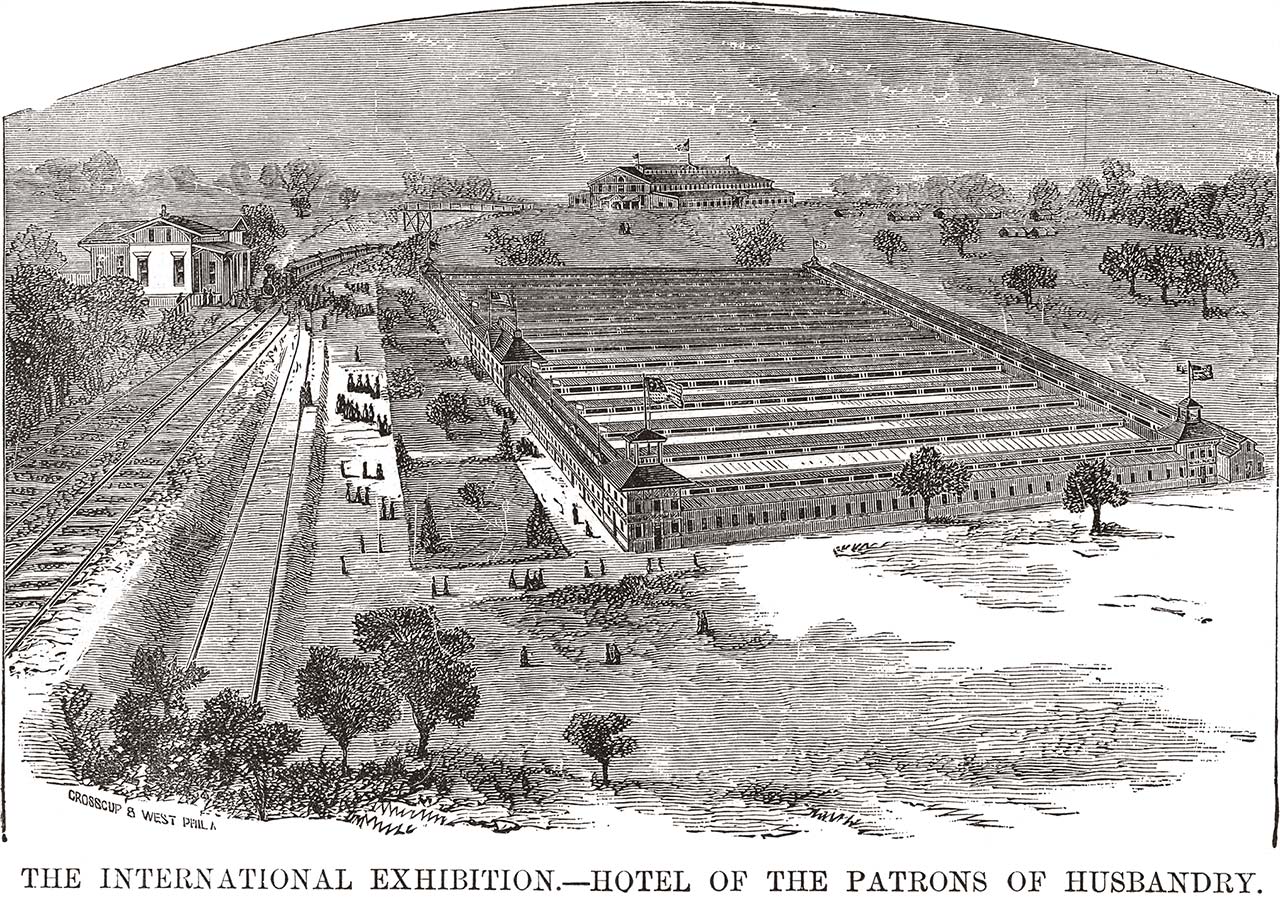
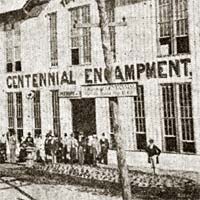
From May to November 1876 the Grangers’ Centennial Encampment covered much of southside Narberth. It contained the largest building ever constructed in Narberth, able to accommodate our entire present-day population. It was the scene of a murder that was reported internationally. Then seven days after the Centennial closed, a spectacular fire burned it to the ground.
On May 4, 1876, six days before the Centennial International Exhibition was to open in Philadelphia's Fairmount Park, local lodgings for the thousands of expected visitors were at a premium. On a widely circulating list, Elm Station (as the vicinity of today's Narberth was then known) had but two: the General Wayne Hotel (capacity 30) and the Wild Wood Boarding-house (10). By far the largest on the Main Line was the Bryn Mawr Hotel with room for 250.
Thus the Centennial Commission, "in order to put an end to the reports of insufficient accommodations", broadcast the notification that "Patrons of Husbandry Camp at Elm Station will accommodate 5000 Persons of that order at $1.50 per day; three miles, by Pennsylvania Railroad, from Exhibition grounds. Fare, round trip, fifteen cents." The National Grange of the Patrons of Husbandry were more commonly known as Grangers.

Patrons of Husbandry was founded in 1867 to offer economic and social community to its mostly rural and agricultural membership and to wrest self-determination and freedom from the economic tyranny of the eastern banks and railroads. It advocated universal suffrage; one contemporary wrote "It has one very remarkable feature, being, I believe, the only secret society into which woman is admitted on terms of full equality with man." In its early years it was devoted to educational events and social gatherings. Within ten years it numbered 800,000 to 1.5 million members at a time when the entire U.S. population stood around 45 million. It proposed, though donations and sale of stock, to crowdfund an affordable way for its vast membership to attend the greatest event of their lifetimes.
Just seven years previously, William Thomas had sold the Pennsylvania Railroad three-quarters of an acre (for one dollar) to build Elm Station. Now, across the tracks, his son Lewis leased forty acres to the Centennial Encampment Association for the purpose of constructing the "largest summer hotel building in the world."
How big was it?
"Gigantic" —Scientific American; "Monster proportions" —Capital and Labour (London). The hotel building had 1,200 rooms that could accommodate by various accounts 3 to 5,000 persons daily. It measured 496 by 450 feet, it encompassed 5.1 acres, enough to hold almost 5 football fields. By comparison, Montgomery Court Apartments, the "Biggest Building in Borough History" (Our Town March 18, 1938), grounds and all, covers 3.03 acres, according to borough records. That makes the Grangers' hotel 69% larger in area.
Or, to compare enormous apples to enormous apples, a building of the hotel's dimensions would cover all of Narberth Park, the baseball field plus the basketball and tennis courts, and throw in the playground and library building for good measure.
And there was much more to the Encampment than this single huge building: an entire campus overspread much of today's south side. "In the splendid dining-hall, a separate building 320 feet long and 80 feet wide, 1,000 guests can be accommodated at a time. The fine kitchen behind it, fit for a duke, or, rather, a dozen dukes, has 30 feet of ranges." It's the building at the top center of the illustration, roughly at the location and of the size of the Woodside apartments at 103-105 S. Narberth.
There was also onsite an icehouse, a dairy, a laundry and a hospital, as well as a Western Union telegraph office, Pennsylvania Railroad baggage and ticket offices, and a U. S. post office. It had its own police force.
We can try to visualize the scale of the Encampment with reference to today's Narberth by drawing buildings of the reported dimensions at the locations depicted in the engraving.
Basemap:
The Encampment hotel and dining hall; click for details.
The Encampment grounds, 40 acres leased from the William Thomas estate.
 The Elm Station Murder crime scene.

Encamping with the Grangers
What a scene the Encampment must have presented! Thousands of visitors from all over the country and around the world, at liberty, many farther from home than they ever had been, or ever would be in their lives, mingled, talked, played, argued and boasted.
Contemporary accounts extol the virtues of the neighborhood, "affording a healthy location, pleasant promenades, romantic and picturesque scenery… the air is pure and bracing." "…in the early flush of the Summer, in the first days of the Exhibition, the place will be a paradise." Furthermore,
The water arrangements are very fine; the Encampment being furnished with clear, cool, sparkling spring water, from a running stream a few yards from the dining hall, and forced through the building by means of an engine.
Your fellow travelers were bound to be congenial, too,
As it is the intention of the Board of Managers to exclude all persons of improper character, they earnestly request all their guests to bring with them their trade cards, certificates of membership, or letters of recommendation, and to introduce no friend into the encampment who does not bear a fair moral record at home. —R. H. Thomas, Sec'y
The range of amenities and services available at the Encampment provided for almost every human want or need, as long as a stiff drink was not required. In accordance with Patrons of Husbandry precepts, it was a "temperance hotel", no alcohol sold or served on the premises. Many of the support positions were filled by the down-to-earth guests themselves, who could thereby earn, instead of spend, a few dollars.
Reported a bemused English journalist who was present
At a dinner given recently by the Encampment to the Press, and followed by a dance, carried on with more spirit than I should have thought it possible to get out of soda-water and lemonade…
There are few, if any, servants, or even "helps" in the ordinary sense of the term. The work usually done by waiters and chambermaids is here done by people in a very different position of life, such as well-to-do farmers' wives… and school teachers…. in the encampment, as Grangers among Grangers, all, in Granger language, "brothers and sisters," … they can claim to be treated on a footing of friendship and equality. … These amateur waitresses are only putting into practice one of the first and prettiest articles of the Granger creed — that labour is not degrading but ennobling.

Mechanicsburg, PA, about 9 miles west of Harrisburg, exemplifies the participation of the local Grange chapters. The Singer Band of Mechanicsburg, still active today, lodged at the Encampment and marched in the Fourth of July parade. According to a 1901 memoir, as they approached Independence Hall, the band wowed the patriotic Philadephia crowd with their Revolutionary War-style uniforms and rendition of Yankee Doodle.
The band's outing sadly turned tragic back at the Encampment that evening. 21-year-old drummer Roger Heffelfinger was killed when lightning struck the roof ventilator he was trying to shut.

On November 10, after six months and ten million visitors, the Exhibition closed. The Encampment emptied of guests, and the staff began to collect and sell the vast collection of furnishings.
“An immense tinderbox destroyed”
—New-York Times. On the evening of Friday, November 17, 1876, exactly one week later, Narberth's largest building was transformed into Narberth's largest fire. Like most of the Centennial construction, it was not built to endure, so the entire 5-acre pine structure was consumed "like sheets of paper… with race-horse speed", in under an hour.
The glare from the conflagration was visible in the night sky throughout the city, which caused many to believe that the entire Exposition was ablaze. Thousands took to the streets and rooftops to try to locate the flames. The city fire department sprang into action, but after ascertaining that the Centennial buildings were secure, they were unable to reach the Encampment on the dark, on unpaved roads that "recent heavy rains had rendered … in the worst possible condition, … little better than a morass".
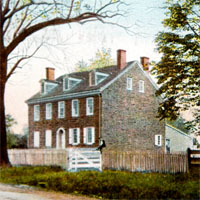
A reporter who did make it wrote that the mountains of furniture and equipment, some of which had already been sold, only served to feed the flames. The inferno threatened to jump the tracks; Elm Station, thirty yards away, twice caught fire "but by great effort Station-master [William] Smick and his assistants succeeded in saving this building from the relentless foe." Even the 1690 Price farmhouse, in 1876 a boarding house located 200 yards beyond the station at today's Forrest and Windsor, was thought in danger.
No deaths were recorded but several were badly burned or narrowly escaped, for example “Mrs. Jones, the steward's wife… The flames burst into her room before she could leave it, and, with her children in her arms, she ran for her life through the blazing corridors.”
The fire at Elm Station was reported across the nation during the succeeding days. Suspicions about its origin were raised immediately. Snarked The Times of Philadelphia the next morning "The Exhibition over, there was, perhaps, no better use to put it to than to make a bonfire of it." Somewhat less cynically, The Baltimore Underwriter: "The fire is believed to have been the work of incendiaries… It is said that some suspicious looking persons were seen leaving the building shortly before the fire."
Hundreds of individuals and local granges who had bought Encampment Association stock lost their investment. "While it lasted it served a useful purpose. However, …it caught fire and was totally destroyed, together with the records of the association. Some of the delegates to the Meadville meeting had invested money in this enterprise and they were not in a cheerful humor."
No one was ever charged or prosecuted for such a deed. The "immense tinderbox", described as being lit by "over a thousand gas-jets", presented almost a blueprint for a fire. The Press of Philadelphia reported "After diligent inquiry it was ascertained that the fire originated in or near the kitchen at the south-east corner, but whether from a [coal?] stove or a gas jet was not known." Perhaps the wonder is that it survived six months.
Murder at Elm Station
Even from the ashes, the Encampment had one more story to tell, a murder mystery at that. On February 21, 1877, three boys walking along the tracks east of Elm Station discovered a human foot protruding from the embankment. For six months the body, clearly a victim of foul play, remained unidentified and was buried in St. Paul's cemetery in Ardmore. “The Elm Station murder” or “the Centennial murder” provided sensational accounts, reported internationally, of trust, betrayal and stolen identity, of tracking down the victim's identity, the manhunt and trial, and the murderer's suicide on the eve of execution. The accomplice's grisly testimony revealed that the crime had been committed October 17, 1876, when the hotel was still open.

You may have heard this story on a Narberth Ghost Walk and for many, it will have been their only previous encounter with the Grangers' Encampment. It's a tale worthy to recount in full elsewhere. If you can't wait for the next Ghost Walk, follow the footnote to links to contemporary and historical accounts of the case.
The Encampment’s legacy
Memory of the Encampment faded as estates and suburbs replaced farms, introducing a new population unfamiliar with the area. Reminiscences that were periodically published in the 20th century often mixed fact and fancy. The Main Line Chronicle's 75th Anniversary of Narberth issue (1970, PDF) quoted Richard J. Hamilton's (1871–1956) recollection of the Grangers' Camp as a row of one-story "shacks, really" along Haverford Avenue, whose glow in the night sky he and his father tracked from Merion Square (Gladwyne) in January 1877, not the huge hotel fire in November 1876 on the opposite side of the tracks. Hamilton was all of 5 years old in 1876, and was being quoted 14 years after his death.
Without a trace? Archaeology at the Encampment

It seems impossible that such a huge construction could have left no trace even after a century and a half. Fifty years later, Our Town of May 8, 1926 reported the "1000-room Hotel in Narberth… stood on the south side, near to the railroad tracks, covering a tract of ground extending from the site of the Baptist Church to Essex avenue. Parts of the foundations are still buried in the backyards of the houses on the north side of Woodside avenue."
With archaeologist Dr. Patrick Mullins, and detectorist and history author Brad Upp, in June 2023 we dug a one-meter/3-foot square hole within the hotel's conjectural footprint to see what evidence we might find of the hotel's construction or destruction.

The hole yielded a clear "plow line" about 24 inches deep, below which we would not expect to find man-made material. Above that were extracted a large number of hand-forged nails, which pre-date the c. 1906 house in whose back yard we dug. We also found numerous pieces of melted glass and other burned material. Given that glass melts at a higher temperature than a wood bonfire or a large trash fire achieves, this is strong evidence of a very intense, very large fire. Indeed, an eyewitness reported in the Philadelphia Press "the heat was so intense that no one not a born salamander could safely approach within 200 feet of the burning mass."

Given that most of today's South Narberth houses are the first structures to be built within the hotel's footprint, there are undoubtedly more artifacts waiting to be found.
Perhaps the Encampment's most consequential legacy was its influence on local landowner Edward R. Price. The developments of 1876, on land that his family had once deeded from William Penn, the gigantic hotel and the even bigger Belmont Driving Park, which opened the same year, had suddenly transformed the quiet agrarian landscape Price had known all his life. Price had no heirs; he now pushed ahead with plans to develop his family's 200-year-old estate, selling the first lots five years later in 1881, the opening step in the development of Narberth as a suburban village. In November 1888, 12 years after the Centennial, the Thomas family sold the land they had leased for the hotel; construction of the homes that stand today started the following year.

Is it an exaggeration to call the Grangers' Centennial Encampment a "lost city"? In defense of its credentials as a city, more people called it home during 1876 than lived in all of Montgomery County. On any given night it was easily the biggest population center on the Main Line.
"Lost", certainly, in collective memory: how many today know of it? Already by 1925 Narberth's Our Town noted that "few realized" that it had existed.
Whether the Grangers' Centennial encampment is Narberth's Pompeii, before south of the tracks was our neighborhood, it was home to a gigantic 19th-century communal and utopian undertaking, family-friendly, affordable to all, with equal participation by women, 50-cent box lunches, and 15 minutes from the greatest public event in the nation's history. In 1876-77 the Encampment, the fire, the murder, brought our neighborhood more attention than ever before, or since.


References
The 1871 Bryn Mawr Hotel was destroyed by fire; its 1890 successor designed by Frank Furness became The Baldwin School. The Wild Wood Boarding-house was probably the 1690 Price farmhouse. Return
"The 'Grangers' at Philadelphia", Capital and Labour, Volume 3 (London, 1876), page 537-39. Return
"The 'Grangers' at Philadelphia" Return
Grange Visitor, Schoolcraft, MI, May 1876 Return
New-York Times, March 20, 1876 Return
All was not entirely egalitarian among the Patrons of Husbandry. Among the staff were, "two or three coloured Gibeonites to perform such very menial work as boot-cleaning and clothes-brushing".
"The 'Grangers' at Philadelphia" is quoted extensively in this essay. I found it one of the most thorough and entertaining contemporary accounts of the Centennial Encampment and the Granger movement, written in a tone at once admiring and ironic. Credited to an unnamed "special correspondent of the Times", it was syndicated in both Capital and Labour (London) and The Country Gentleman's Magazine (London, Edinburgh, Dublin). Return
Descriptions by visiting Grange members tend to the sober and prosaic. Jurian Winne 1816–86, who visited from New York:
 As one of my principal objects was to learn more about our great Grange encampment, I visited that place the first afternoon, and found it at Elm Station, on the Pen[n]sylvania Railroad about two miles from the Fair Grounds, and although unpretentious and plain, still it is large and well arranged. Mr. Painter, one of the board of managers, showed me through the length and breadth of it, from the parlors down to the kitchen, and I can assure my friends that every thing I saw was arranged for cleanliness and comfort; the very essentials for our grange ladies as well as ourselves. The hotel has 1,200 rooms, and can accommodate from 2,000 to 4,000 persons, and is specially designed for the Patrons of Husbandry, although others will also be accommodated there. The building is 496 feet in length, 450 deep, and only ten minutes' ride from the Exposition, with trains going to and from about every 30 minutes. The rooms are each provided with a new double bed (mattress and springs), chairs, table and mirror, wash-stand, &c.; the sides are papered, and the room provided with lock and key. The building is lighted with gas, and well ventilated, and the rooms mostly are on the first floor, and conveniently connected with the offices, dining rooms, wash rooms, closets, &c. The reception and sitting rooms are large, pleasant and convenient. The dining room will seat 1,000 guests at a time, and is managed by brothers of the order. The substantials, and even the delicacies of the season, are promised in abundance, and of the best the market will afford. The services of a Mr. Martin, of 30 years' experience as caterer and manager at popular summer resorts, have been secured, and this department (the essential one) is promised to surpass any hotel in Philadelphia. Telegraph, express, baggage and mail accommodations are also provided, as well as laundry; also a large hall for Grange and other meetings, and the hall will be used for religious services on the Sabbath. No intoxicating liquors will be allowed to be sold on the premises. Also a competent police force, watchmen, fire brigade and safe for the deposit of money, &c., are provided, also a building for the care of sick (should any be so unfortunate), with a competent physician.
Source: The Cultivator & Country Gentleman, Volume 41, Albany (Luther Tucker & Son, 1876), p. 373, June 15, 1876
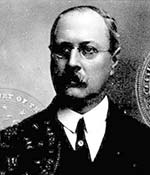 Note: William Thatcher Painter 1836–1904, "one of the board of managers" was a member of Pennsylvania's Brandywine Grange No. 60, still active today in Chester county. His son George Minshall Painter (left, in 1915), who was 9 in May 1876, also worked at the Encampment, as noted in Our Town, May 8, 1926: "Mr. Painter can describe in vivid terms the task of distributing room equipment which arrived the very day the hotel opened." Several Painter descendants today live in the vicinity of Narberth.
"A Paradise for the Grangers", New-York Times, March 20, 1876; R. H. Thomas image: Findagrave.com Return
Many of the fire's details come from "A FIERY FINALE", an unattributed report in The Press of Philadelphia, November 18, 1876, page 8. It gives a somewhat sensational account of locating and reaching the fire, and what the reporter witnessed when he got there. It paints the 1876 Main Line as a literal backwater that night. Return
End of the Grangers' Hostelrie., The Baltimore Underwriter: A Monthly Publication Devoted to the Interests of Insurance, Vol. XVI, July-December 1876, page 329 Return
Fred Brenckman, History of the Pennsylvania State Grange, page 52 (Pennsylvania State Grange, Harrisburg, 1949). Return
The Press of Philadelphia, November 18, 1876, page 8. Return
Charles R. Barker, The Haverford-and-Merion Road to Philadelphia: A Walk Over an Old Trail, in The Pennsylvania Magazine of History and Biography Vol. 58, No. 3 (1934), page 242. Return
Read about the Elm Station murder in How A Murder Mystery Was Solved in 1877, written 1943, and reported as it developed in The New York Times, 1877–78 (PDF). Return
Even though Hamilton's account contains so many inaccuracies, we should not dismiss it entirely. It may be that a row of shacks did temporarily accompany the Encampment, across the tracks. There was a "shantytown" fire September 9, 1876 just outside the Centennial, across Elm Ave. (today Parkside Ave.).
"We could see the sky lit up from the windows of our parlor [in Gladwyne]. Grangers Camp was strung along Haverford Ave., opposite the railroad station. The place was called Elm then. The camp was a row of one-story whitewashed wooden buildings. Shacks, really. Burned out completely from one end to the other. Many persons thought someone touched it off as the best way to get rid of them." Return
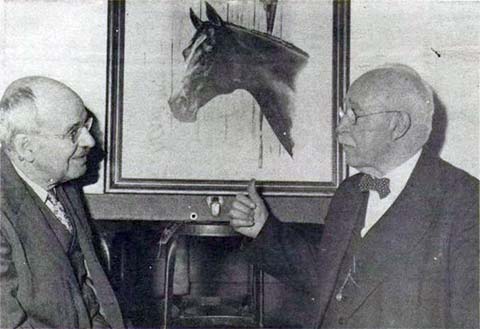
Richard Hamilton (left) and Luther Parsons (1858–1955), who worked at the Encampment as an eighteen-year old. They are pictured here in the 1950s, as officers of The Lower Merion Society for the Detection and Prosecution of Horse Thieves and the Recovery of Stolen Horses. Our Town 2/28/1925, page one: "located on the south side just west of the Baptist church". Return
What is the Temperature of Fire?: "A household wood fire burns at around 600°C [1,112°F]. A bonfire gradually heats up to around 600°C, but can reach 1000-1100°C [2,012°F]."
Melting Point of Glass, in The Physics Factbook: "Depending on its composition, [glass] can have a melting point of about 1400–1600°C [2552–2912°F]. There are glasses that will melt at lower temperatures but those are not common among commercial nor industrial usage." Return
"The 'Grangers' at Philadelphia" (London, 1876) Return
The 1880 census enumerated 6,287 souls in Lower Merion. In 1884 "Bryn Mawr is regarded as the most populous place in Lower Merion, and is supposed to contain about three hundred houses [1,200 people?] within a radius of a mile of its station." 1880 Ardmore had an estimated population of 519. (William J. Buck, History of Montgomery County, Pennsylvania, Philadelphia 1884). The hotel could have held 2020 Narberth's entire population of 4,492. Return
Updated August 18, 2026.